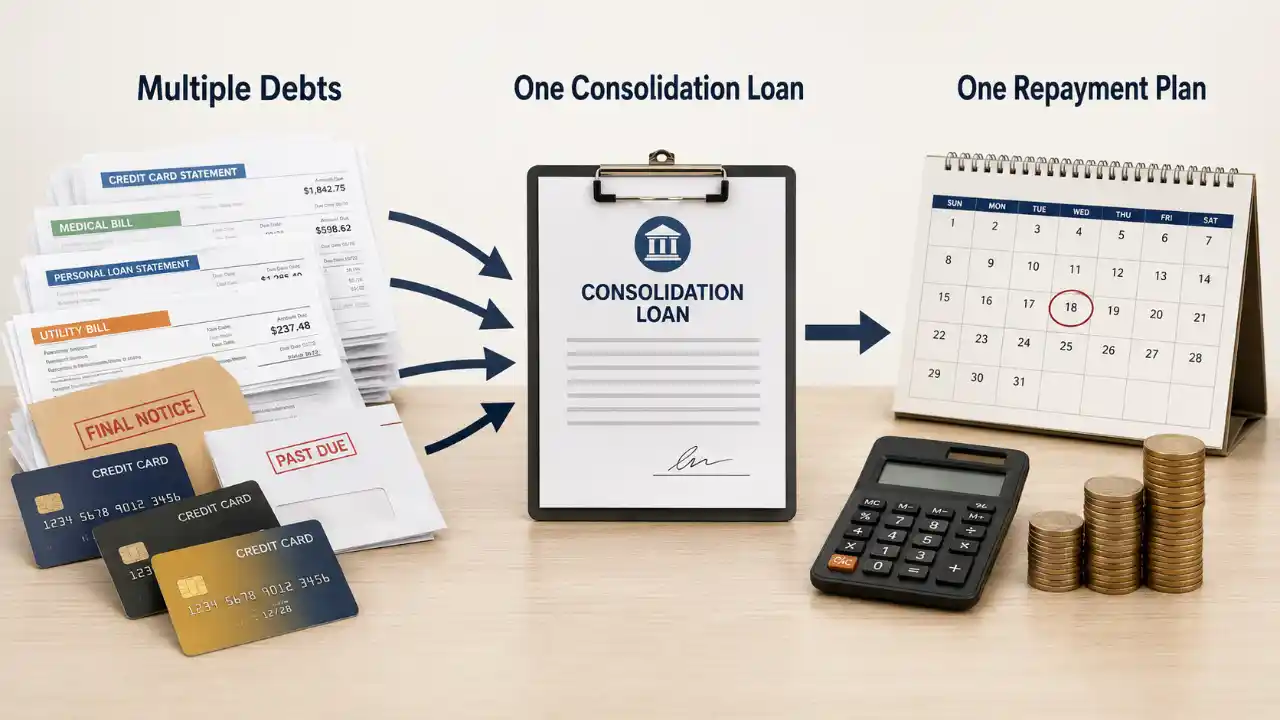
Personal Loans vs. Credit Cards: Interest Rates, Fees, Credit Limits, and Borrowing Costs
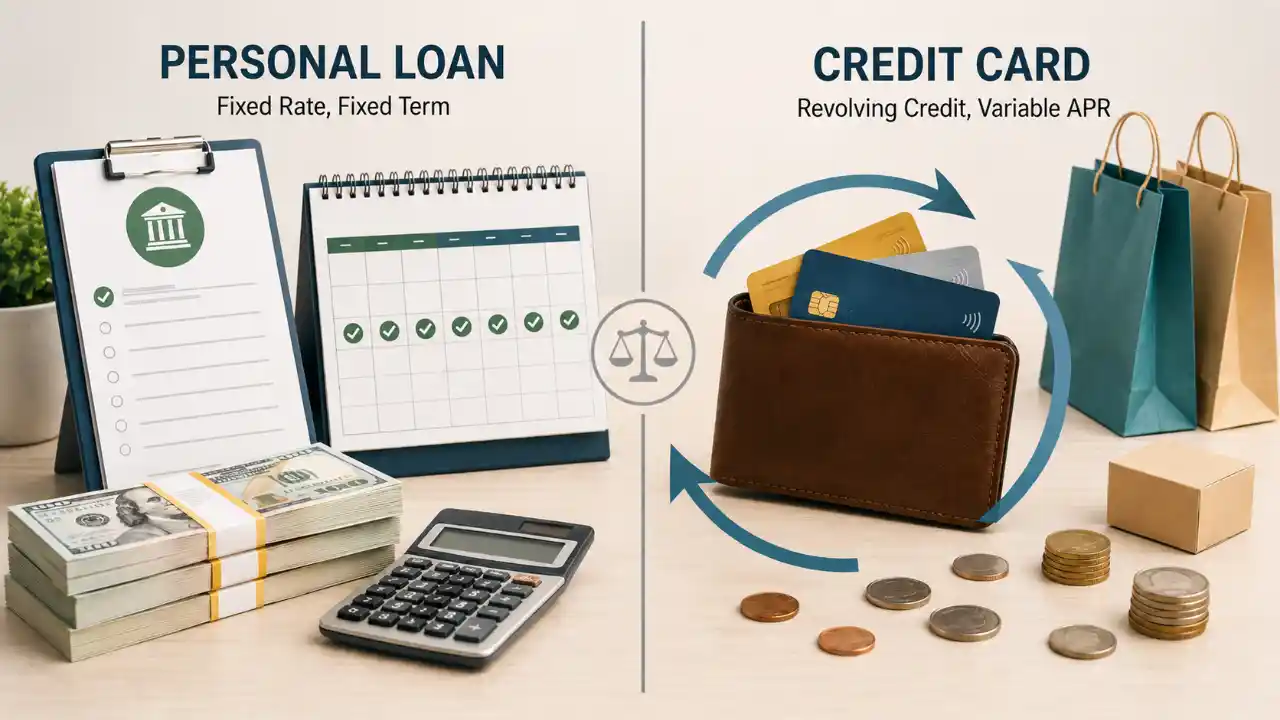
Personal loans and credit cards both provide access to borrowed money, but they work differently. A personal loan generally provides a fixed amount that is repaid in installments, while a credit card provides revolving credit up to an approved limit. The lower-cost option depends on APR, fees, repayment time, borrowing behavior, and whether a credit card balance is paid in full.
Key Takeaways
- Personal loans generally provide a lump sum with scheduled installment payments over a defined repayment period.
- Credit cards provide revolving credit that can be reused as balances are repaid, subject to the account’s credit limit and terms.
- Federal Reserve data for 2026 Q2 show different average borrowing rates for 24-month commercial-bank personal loans and credit card accounts assessed interest, but those averages are not individual offers.
- A credit card can produce little or no purchase interest when an applicable grace period exists and the balance is paid in full by the due date. Carrying a balance changes that comparison.
- The best comparison is not simply personal loan rates vs. credit card interest rates. APR, fees, payment structure, borrowing duration, and total repayment all matter.This guide explains how personal loans and credit cards differ, how to compare their borrowing costs, when fees matter, how credit limits affect flexibility, and which structure may be more appropriate for different borrowing situations.
How Do Personal Loans and Credit Cards Work Differently?
The main difference is that a personal loan is generally closed-end installment credit, while a credit card is revolving credit.The Consumer Financial Protection Bureau defines a personal installment loan as a loan in which the borrower receives a sum of money and generally repays it in fixed installments over a specified period.A credit card, by contrast, is an open-ended borrowing arrangement. A cardholder may borrow up to an approved credit limit, repay some or all of the balance, and continue borrowing as available credit is restored.A simplified comparison looks like this:
| Feature | Personal Loan | Credit Card |
|---|---|---|
| Credit structure | Installment loan | Revolving credit |
| Access to funds | Usually one loan amount upfront | Borrow as needed up to available credit |
| Repayment | Scheduled installments | Minimum payment required; balance can revolve |
| Payoff timeline | Defined by loan term | No fixed payoff date if minimums are maintained |
| Interest structure | Based on loan terms and APR | APR may vary by transaction type and account terms |
| Reuse after repayment | Usually requires a new loan | Available credit can generally be reused |
Neither structure is automatically better.A personal loan may fit a known, one-time borrowing need that can be repaid over a defined schedule. A credit card may provide more flexibility for smaller or recurring purchases, especially when purchases can be paid in full within an applicable grace period.
How Do Personal Loan Rates Compare With Credit Card Interest Rates?
Personal loan rates can be lower than credit card interest rates in some circumstances, but individual pricing varies substantially.The Federal Reserve’s Consumer Credit G.19 release dated August 7, 2026 reported an average rate of 11.86% for 24-month personal loans at commercial banks during the second quarter of 2026. The same release reported 22.15% for credit card accounts assessed interest.These figures provide market context rather than a prediction of what a specific borrower will receive.Personal loan rates can vary with underwriting, credit history, income, debt obligations, loan size, repayment term, lender, and other factors. Credit card issuers may also set an applicant’s interest rate based partly on information in the application and credit history.The Federal Reserve comparison therefore does not mean:Personal loan = 11.86%Credit card = 22.15%for every borrower.Instead, it shows that the two products can have materially different average borrowing costs when interest is actually being charged.
Why Can a Credit Card Still Be Cheaper Than a Personal Loan?
A credit card can be less expensive for short-term purchases when the account provides a grace period and the purchase balance is paid in full by the due date.The CFPB explains that most credit cards provide a grace period on purchases, although issuers are not legally required to provide one. When an applicable grace period exists and the cardholder is not carrying a balance, paying the balance in full by the due date can avoid interest on new purchases.Suppose a $1,500 expense is charged to a credit card and fully paid by the due date while the account qualifies for its purchase grace period.The borrowing interest on that purchase may be $0.Taking a personal loan for the same $1,500 could involve interest and potentially additional loan fees.However, the comparison changes if the credit card balance is carried from month to month.Many issuers calculate credit card interest daily using account balances, and a card can also have different APRs for purchases, cash advances, balance transfers, or other transaction categories.Therefore:Credit card APR higher than personal loan APR ≠ credit card always costs more.If the card balance is paid in full under an applicable grace period, the actual purchase-interest cost may be very different from the stated APR.
How Should APR Be Compared?
APR should be compared together with fees, repayment period, and actual expected borrowing behavior.For loans, the CFPB explains that the interest rate represents the basic cost of borrowing, while APR includes the interest rate plus additional loan fees used in the APR calculation.For credit cards, interest rates are generally expressed as annual percentage rates as well, but the account can have more than one APR depending on the transaction.A useful comparison framework is:
| Cost Factor | Personal Loan | Credit Card |
|---|---|---|
| APR | Compare disclosed loan APR | Check purchase APR and other applicable APRs |
| Upfront fees | May include origination or other charges | May include annual or transaction fees |
| Interest timing | Based on loan terms | Purchase interest may be avoided under a qualifying grace period |
| Repayment duration | Set by loan term | Depends heavily on payment behavior |
| Total cost | More predictable under fixed repayment assumptions | Can vary significantly with balance and payment patterns |
APR is an important starting point, but it is not the entire decision.
Which Fees Matter Most?
Both personal loans and credit cards can involve fees, but the types of fees differ.The CFPB states that personal installment loans may include charges that contribute to the overall borrowing cost and recommends reviewing the lender’s loan disclosure carefully.Potential personal loan charges can include:
- Origination fees
- Application or processing charges, where applicable
- Late-payment fees
- Returned-payment fees
- Optional products or services
- Other charges listed in the loan agreementSome loan fees can also affect the amount of money actually delivered to the borrower.For example, a borrower approved for a $10,000 loan may receive less than $10,000 in usable proceeds if an applicable charge is withheld from the amount advanced.Credit cards can involve different charges, such as:
- Annual fees
- Balance-transfer fees
- Cash-advance fees
- Late-payment fees
- Foreign transaction fees, depending on the card
- Other transaction-specific chargesThe actual card agreement should be reviewed rather than assuming all credit cards charge the same fees.
How Do Credit Limits Differ From Personal Loan Amounts?
A credit card limit is a revolving ceiling on how much credit may be available, while a personal loan generally provides an approved amount at the beginning of the loan.The CFPB explains that credit card companies generally determine a credit limit after reviewing factors such as credit history and income information supplied in the application.Once the card is open, the balance generally uses part of that available credit.For example:Credit limit: $8,000Current balance: $2,500Remaining available credit: approximately $5,500, subject to pending transactions and issuer rulesAfter part of the balance is repaid, available credit can generally be restored and borrowed again.A personal installment loan works differently.If a lender approves a $10,000 personal loan, the loan generally provides that amount according to the loan agreement and then enters repayment. Paying the balance down does not normally create a reusable $10,000 credit line. A new borrowing need generally requires another credit arrangement.This creates a basic tradeoff:Credit card→ More reusable borrowing flexibilityPersonal loan→ More defined borrowing amount and repayment schedule
Which Has More Predictable Repayment Costs?
A personal installment loan generally provides a more defined payoff schedule than revolving credit card debt.A closed-end personal installment loan is designed to be repaid over a specified period in scheduled installments.With a credit card, a cardholder can carry an unpaid balance from month to month as long as required payments are made according to the account terms. There is no single fixed payoff date inherent in the revolving structure.This difference can matter for budgeting.A personal loan may provide:Known starting balance→ Scheduled installments→ Defined repayment periodA credit card can look more like:Balance
- New purchases− Payments
- Interest
- Applicable fees→ Changing monthly balanceCredit cards can therefore provide greater flexibility, but that flexibility can make total borrowing cost less predictable when balances are carried.
A $5,000 Borrowing-Cost Example
Consider a hypothetical $5,000 balance repaid over 24 months.Assume one option is modeled as a 24-month installment loan at 12% with no additional fees.Approximate monthly payment: $235Approximate total interest: $649Now model the same $5,000 balance at 22% over the same 24-month payoff period using equal monthly payments.Approximate monthly payment: $259Approximate total interest: $1,225Under these assumptions, the higher-rate balance produces approximately $576 more interest.These are mathematical illustrations, not actual personal loan or credit card offers.The example intentionally holds the principal and repayment period constant so that the interest-rate difference is easier to see. Real credit card repayment can differ because cardholders may add purchases, change payment amounts, face different APRs, or qualify for a grace period.The example also does not mean that a borrower will receive a 12% personal loan or a 22% credit card APR.
When May a Personal Loan Be More Suitable?
A personal loan may be more suitable when the borrowing need is defined and the borrower values a structured repayment timeline.
A Large One-Time Expense
A personal loan can provide a defined amount for a large purchase or unexpected expense and spread repayment across scheduled installments.
Consolidating Existing High-Rate Debt
A personal loan may be considered for debt consolidation when its APR, fees, and repayment term compare favorably with existing obligations.That comparison should be based on overall cost, not simply a lower monthly payment.
A Need for a Clear Payoff Date
A fixed installment schedule may be useful when the borrower wants a specific repayment horizon rather than an open-ended revolving balance.These situations do not mean a personal loan is automatically cheaper. Qualification, fees, and repayment terms still matter.
When May a Credit Card Be More Suitable?
A credit card may be more suitable when flexibility matters and the expected balance can be managed within a short timeframe.
Purchases That Can Be Paid in Full
If a card provides a purchase grace period and the balance is paid in full by the due date, purchase interest may be avoided.
Repeated Smaller Purchases
A revolving credit line can be reused as payments restore available credit, which can be more convenient than repeatedly applying for installment loans.
Uncertain Borrowing Amounts
When the exact borrowing need is not known in advance, a revolving credit card can provide ongoing access up to the available limit.However, convenience should not be confused with low borrowing cost. Carrying significant revolving balances at high credit card interest rates can materially increase interest expense.
What About Cash Advances and Balance Transfers?
Cash advances and balance transfers should be evaluated separately from ordinary credit card purchases.A credit card may apply different APRs to purchases, cash advances, and balance transfers.Cash advances can be particularly expensive because they may involve transaction fees and can begin accruing interest immediately rather than receiving the grace-period treatment commonly associated with qualifying purchases.Balance-transfer promotions require similar caution.A promotional transfer rate may apply to the transferred balance while new purchases accrue interest under different rules. Carrying a promotional balance can also affect whether new purchases receive a grace period.Therefore:Purchase APR≠ Balance-transfer APR≠ Cash-advance APRThe applicable transaction type matters.
How Can Personal Loans and Credit Cards Affect Credit?
Both can affect a credit profile, but they do so through somewhat different structures.Applying for either product may result in a hard credit inquiry. Hard inquiries may affect FICO Scores, although the effect depends on the broader credit profile.FICO explains that its rate-shopping treatment is designed for certain mortgage, auto, and student-loan inquiries made within specified shopping periods. Ordinary personal-loan inquiries should not automatically be assumed to receive the same treatment.Credit cards also directly affect revolving credit utilization because their balances and credit limits are part of the revolving-credit structure.Personal installment loan balances are structurally different from revolving credit-card utilization.That means choosing one product solely because it is expected to “improve a credit score” is not a reliable strategy.Personal loans do not guarantee a higher credit score.Credit cards do not guarantee a higher credit score.Payment history, balances, new credit, account age, utilization, and the broader credit file can all matter.
A Five-Factor Personal Loan vs. Credit Card Decision Framework
Instead of asking which product is universally better, compare five factors.
1. Expected Borrowing Period
Will the balance be repaid within one billing cycle, several months, or multiple years?Short-term borrowing that can be paid in full may make a credit card’s grace period particularly relevant.Longer-term borrowing makes APR and repayment structure more important.
2. APR
Compare the actual APRs offered, not national averages or advertised “starting at” rates.
3. Fees
Include origination fees, annual fees, transfer fees, cash-advance charges, and other applicable costs.
4. Repayment Structure
Determine whether a defined installment schedule or reusable revolving credit better matches the borrowing need.
5. Borrowing Behavior
Consider whether access to reusable credit could lead to additional balances.The decision framework can be summarized as:Short-term purchase + full payoff capability→ Credit card may have a cost advantage if a grace period appliesLarger fixed expense + multi-month repayment→ Personal loan may provide a more predictable structureRepeated flexible spending→ Credit card offers greater flexibilityHigh revolving balance + lower-rate loan offer→ Personal loan may deserve comparison for refinancingThese are comparison scenarios, not guaranteed recommendations.
Personal Loan vs. Credit Card Checklist
Before borrowing, review:
- How much money is actually needed?
- Is the expense one-time or recurring?
- What APR is actually being offered?
- Is the rate fixed, variable, or promotional?
- Which fees apply?
- Does the card offer an applicable grace period?
- Will the full card balance be paid by the due date?
- What is the personal loan’s repayment term?
- What will total repayment be under the expected schedule?
- Is the card being used for purchases, balance transfers, or cash advances?
- Does the credit limit provide enough available credit?
- Could reusable credit encourage additional borrowing?
- Does the payment fit the budget without relying on additional debt?
Common Personal Loan vs. Credit Card Mistakes
Comparing Only Advertised Rates
A low advertised rate may not be the rate actually offered, and fees can change the total borrowing cost.
Ignoring a Credit Card Grace Period
A card’s stated APR does not necessarily mean interest will be charged on every purchase. When a qualifying grace period applies and the balance is paid in full, purchase interest may be avoided.
Treating Minimum Payments as a Repayment Plan
A minimum payment keeps an account moving according to its terms, but it does not necessarily create a fast or low-cost payoff strategy.
Ignoring Personal Loan Fees
Personal loan fees can materially affect the amount received and the overall borrowing cost.
Using Cash Advances Like Ordinary Purchases
Cash advances can have different APRs, transaction fees, and interest timing from regular purchases.
Assuming One Product Is Always Cheaper
The actual result depends on how long money is borrowed, whether fees apply, the APR offered, and how quickly the debt is repaid.
Troubleshooting: What If Neither Option Looks Affordable?
If both the personal loan payment and expected credit card repayment appear difficult to manage, adding debt may not solve the underlying cash-flow problem.First, separate the borrowing need into:Essential expensevs.Deferrable expenseThen estimate the payment required to repay the balance within a realistic period.If the expected payment does not fit the budget, alternatives may include reducing the amount borrowed, delaying a nonessential expense, contacting existing creditors about available options, or seeking reputable nonprofit credit counseling where appropriate.Repeatedly moving debt between products without reducing the underlying balance can extend repayment and increase costs.
Final Takeaway
The personal loan vs. credit card decision depends less on the product name than on how the money will actually be borrowed and repaid.A personal loan may be more useful for a defined expense when a structured installment schedule, predictable payoff period, and competitive APR are important.A credit card may be more useful for flexible or short-term purchases, especially when an applicable grace period allows the purchase balance to be paid in full without interest.For borrowers expecting to carry a balance for many months, personal loan rates, credit card interest rates, applicable fees, and total repayment should be compared directly.For borrowers who expect to pay a purchase in full by the next due date, the credit card grace period can materially change the cost comparison.The practical decision sequence is:Borrowing amount→ Borrowing duration→ APR→ Fees→ Repayment structure→ Total expected cost→ Flexibility neededNeither personal loans nor credit cards are automatically cheaper in every situation.
Frequently Asked Questions
Is a personal loan usually cheaper than a credit card?
Not always.Federal Reserve averages show that 24-month commercial-bank personal loan rates were below average rates on credit card accounts assessed interest in 2026 Q2, but individual offers can differ substantially.A credit card may also produce no purchase interest when an applicable grace period exists and the balance is paid in full.
Is It Better to Use a Personal Loan for a Large Purchase?
A personal loan may provide a clearer repayment schedule for a large fixed expense, but whether it is financially preferable depends on APR, fees, repayment term, and available alternatives.A credit card could cost less for a short-term purchase that can be paid in full under a qualifying grace period.
Do Personal Loans Have Credit Limits?
A personal installment loan generally has an approved loan amount rather than a reusable revolving credit limit.Once the loan is issued, repayment reduces the balance but does not normally restore reusable borrowing capacity in the same way that paying down a credit card restores available revolving credit.
Can a Credit Card Be Cheaper Even With a Higher APR?
Yes.If a card provides a grace period on purchases and the applicable balance is paid in full by the due date, purchase interest may be avoided.In that situation, the stated credit card APR may not translate into actual interest charges on that purchase.
Does Applying for a Personal Loan or Credit Card Affect Credit?
Either application may involve a hard inquiry, which can affect a credit score depending on the scoring model and overall credit profile.FICO’s rate-shopping guidance explains that special inquiry treatment applies to certain mortgage, auto, and student-loan shopping rather than automatically to every type of consumer loan inquiry.
Should Credit Card APR Be Compared Directly With Personal Loan APR?
APR is a useful starting point, but the comparison should also include fees and repayment behavior.A personal loan may have origination charges, while a credit card may have annual, balance-transfer, or cash-advance fees. A credit card grace period can also make actual purchase-interest cost different from what the headline APR alone suggests.
Financial Information Notice
This article provides general educational information and is not individualized financial, credit, tax, or legal advice. Personal loan approval, credit card approval, interest rates, APRs, fees, credit limits, credit-score effects, and repayment outcomes can vary by lender or issuer, product terms, credit profile, income, debt obligations, scoring model, and individual financial circumstances.
Sources
Consumer Financial Protection Bureau — “What is a personal installment loan?”https://www.consumerfinance.gov/ask-cfpb/what-is-a-personal-installment-loan-en-2114/Consumer Financial Protection Bureau — “Do personal installment loans have fees?”https://www.consumerfinance.gov/ask-cfpb/do-personal-installment-loans-have-fees-en-2120/Consumer Financial Protection Bureau — “What is the difference between a loan interest rate and the APR?”https://www.consumerfinance.gov/ask-cfpb/what-is-the-difference-between-a-loan-interest-rate-and-the-apr-en-733/Consumer Financial Protection Bureau — “What is a grace period for a credit card?”https://www.consumerfinance.gov/ask-cfpb/what-is-a-grace-period-for-a-credit-card-en-47/Consumer Financial Protection Bureau — “How does my credit card company calculate the amount of interest I owe?”https://www.consumerfinance.gov/ask-cfpb/how-does-my-credit-card-company-calculate-the-amount-of-interest-i-owe-en-51/Consumer Financial Protection Bureau — Credit Cards Key Termshttps://www.consumerfinance.gov/consumer-tools/credit-cards/answers/key-terms/Board of Governors of the Federal Reserve System — Consumer Credit G.19 — August 7, 2026https://www.federalreserve.gov/releases/g19/current/FICO — “How to Rate Shop and Minimize the Impact to Your FICO® Scores”https://www.myfico.com/credit-education/blog/rate-shopSource information checked August 17, 2026.