How Credit Scores Can Affect Loan Approval, Interest Rates, and Borrowing Costs
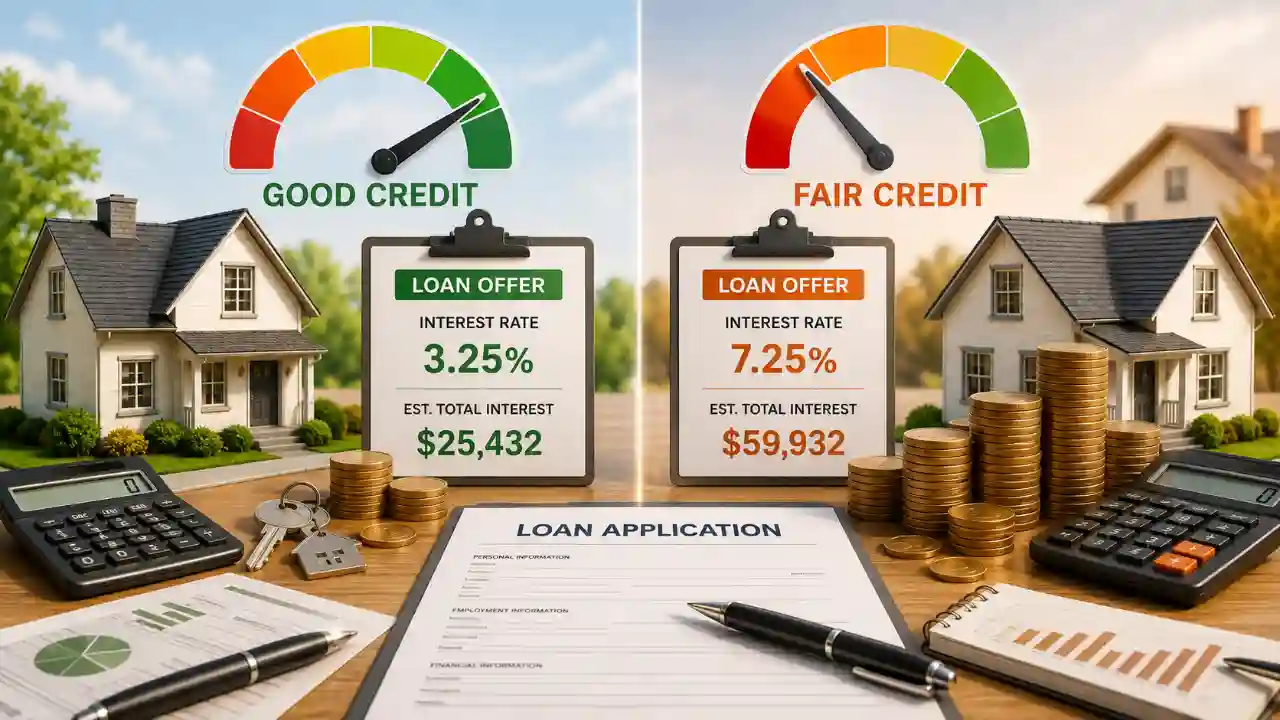
A credit score can affect whether a lender approves a loan, the interest rate or APR offered, and how much borrowing ultimately costs. Higher scores generally indicate lower estimated credit risk and may improve access to more favorable terms. However, no particular credit score guarantees loan approval or a specific interest rate because lenders also evaluate income, debt, loan structure, and other underwriting factors. (consumerfinance.gov)
Key Takeaways
- A credit score can influence both loan approval and loan pricing, but it is only one part of underwriting.
- Higher credit scores generally may help borrowers qualify for lower loan interest rates or more lender choices, although results vary by lender and loan type. (consumerfinance.gov)
- Interest rate and APR measure different aspects of borrowing costs. APR can include certain lender charges in addition to interest. (consumerfinance.gov)
- The credit score used for mortgage lending may differ from a score shown in a consumer app because lenders can use different scoring models, credit-report data, and underwriting systems. (myfico.com)
- A relatively small difference in interest rate can produce a much larger difference in total interest when the loan balance or repayment period is large.This guide explains how credit scores can affect loan approval, personal loan rates, mortgage pricing, monthly payments, APR, and total borrowing costs. It also provides a practical framework for evaluating loan offers without treating any credit-score number as a guaranteed approval or pricing threshold.
How Does a Credit Score Affect Loan Approval?
A credit score helps a lender estimate credit risk, but it does not make the lending decision by itself.The Consumer Financial Protection Bureau defines a credit score as a prediction of credit behavior, such as how likely a consumer is to repay a loan on time, based on information contained in credit reports. (consumerfinance.gov)FICO similarly explains that lenders establish their own approval criteria and may consider factors such as income, debt, credit history, loan type, and their own risk tolerance. There is no single minimum credit score required by every lender. (myfico.com)A lending decision can therefore be viewed through several separate factors:
| Decision Factor | What a Lender May Evaluate | Possible Effect |
|---|---|---|
| Credit profile | Credit score, payment history, balances, recent credit activity | Approval and pricing |
| Ability to repay | Income and existing monthly obligations | Approval and loan amount |
| Loan structure | Loan amount, repayment term, collateral, down payment | Approval and pricing |
| Underwriting policy | Lender or loan-program requirements | Eligibility |
| Market conditions | Funding costs and broader interest-rate conditions | Available pricing |
For mortgage lending specifically, the CFPB explains that credit scores and credit-report information affect qualification and rates, while lenders also consider information such as income, debt, savings, and assets. (consumerfinance.gov)The practical conclusion is:Credit score ≠ automatic loan approval.Two applicants with the same score may receive different decisions because their income, existing debts, requested loan amounts, collateral, credit history, or loan programs are different.A higher score may improve an applicant's position, but it does not override every other underwriting factor.
How Can a Credit Score Affect Loan Interest Rates?
Credit scores can affect loan interest rates because lenders may use credit risk when determining pricing.In general, consumers with higher scores may be offered lower interest rates than consumers with lower scores when other factors are comparable. The CFPB also notes that consumers applying with higher credit scores generally may have access to more affordable mortgage loans and more lenders. (consumerfinance.gov)The relationship is better understood as:Credit Profile → Risk Assessment → Approval and PricingIt should not be interpreted as:Specific Credit Score → Guaranteed Interest RateA lender might use score ranges, proprietary underwriting models, additional credit-report information, or a combination of factors when determining an offer.That means a 20-point increase in a credit score does not have a universal financial value.It would be inaccurate to say that increasing a score from one specific number to another will automatically reduce a loan rate by a fixed percentage. Different lenders may price the same credit profile differently, and market conditions can change independently of the borrower's credit.
Interest Rate vs. APR: Which Better Reflects Borrowing Costs?
Interest rate and APR answer related but different questions.An interest rate represents the cost charged for borrowing the principal. Annual percentage rate, or APR, is a broader measure that generally incorporates the interest rate plus certain additional lender charges. (consumerfinance.gov)For mortgages, the CFPB explains that APR may also reflect items such as points, mortgage broker fees, and other charges associated with obtaining the loan. (consumerfinance.gov)Consider this simplified comparison:
| Loan | Interest Rate | APR |
|---|---|---|
| Loan A | 8.00% | 8.40% |
| Loan B | 7.80% | 8.70% |
Loan B has the lower stated interest rate, but its higher APR may indicate higher applicable charges under the assumptions used to calculate the APR.This does not automatically make Loan A the better loan. Loan term, fees, payment structure, and how long the borrower expects to keep the loan can also matter.A more complete comparison examines:
- interest rate
- APR
- loan amount
- repayment term
- monthly payment
- lender or origination fees
- total interest
- total amount repaid
- prepayment provisions when applicableFor comparable loans, reviewing both rate and APR usually provides more information than looking at an advertised interest rate alone.
How Much Can Different Loan Interest Rates Change Borrowing Costs?
A rate difference can affect both the required monthly payment and the total amount of interest paid.The impact generally becomes larger when the loan balance is higher or the repayment period is longer.
Personal Loan Example
Consider a hypothetical $25,000 personal loan with a 60-month repayment term.The 8% and 14% rates below are hypothetical examples used only to demonstrate loan mathematics. They are not current market quotes, are not advertised personal loan rates, and do not represent rates that any particular credit score is guaranteed to receive.
| Example | Hypothetical Rate | Approx. Monthly Payment | Approx. Total Interest |
|---|---|---|---|
| Loan A | 8% | $507 | $5,415 |
| Loan B | 14% | $582 | $9,902 |
Under these assumptions, Loan B would require about $75 more per month and approximately $4,488 more in total interest over the five-year term.The example demonstrates the effect of different loan interest rates after rates have been established. It does not mean that one credit score produces an 8% personal loan rate and another produces a 14% rate.Actual personal loan rates and approval standards depend on the lender, credit profile, income, debt, loan amount, term, market conditions, and other underwriting factors.
Mortgage Example
The effect of rate differences can become much larger on a long-term mortgage.Consider two hypothetical 30-year fixed-rate mortgages with the same $350,000 principal balance.The 6.25% and 7.25% rates below are illustrative assumptions only. They are not current mortgage-rate quotes and do not represent guaranteed rates for any credit-score range.
| Example | Hypothetical Rate | Approx. Monthly Principal & Interest | Approx. Total Interest |
|---|---|---|---|
| Mortgage A | 6.25% | $2,155 | $425,804 |
| Mortgage B | 7.25% | $2,388 | $509,542 |
Under those assumptions, the higher-rate mortgage would require approximately $233 more per month in principal and interest and roughly $83,738 more in total interest if both loans remained outstanding for the full 30 years and all scheduled payments were made.These calculations exclude property taxes, homeowners insurance, mortgage insurance, closing costs, fees, refinancing, early payoff, and other possible costs.The purpose of the comparison is mathematical rather than predictive:A relatively small rate difference can become financially significant when applied to a large balance for many years.
How Does the Credit Score for Mortgage Lending Work?
A credit score can be important in mortgage underwriting, but there is no single nationwide score that guarantees approval for every mortgage.Consumers can have multiple legitimate credit scores because different credit bureaus, scoring models, model versions, and reporting dates may produce different results. FICO also explains that lenders may use industry-specific scores or other versions rather than the exact score a consumer sees through a monitoring service. (myfico.com)This distinction matters when someone searches for a “credit score for mortgage” and assumes a number displayed in an app will necessarily be the number used by the lender.It may not be.
Mortgage Credit-Score Models Are Changing
Mortgage credit scoring is also undergoing a significant transition.As of August 17, 2026, the Federal Housing Finance Agency states that approved lenders may choose between Classic FICO and VantageScore 4.0 for loans sold to Fannie Mae and Freddie Mac. FHFA also states that FICO 10T remains an approved model and is planned for future use by the Enterprises. (fhfa.gov)Because this implementation is evolving, mortgage credit-score information should be checked periodically rather than treated as permanently fixed.The current FHFA policy also demonstrates why statements such as “every mortgage uses the same FICO score” or “this is the minimum score required for every mortgage” are too broad.
What Changed With Fannie Mae Desktop Underwriter?
Fannie Mae made a separate underwriting change beginning November 15, 2025.Fannie Mae states that its Desktop Underwriter, or DU, no longer requires a minimum third-party credit score for DU's proprietary credit-risk assessment. Instead, DU uses Fannie Mae's broader proprietary risk assessment to evaluate whether the loan meets the applicable credit-risk threshold. (singlefamily.fanniemae.com)That change does not mean credit scores no longer matter in mortgage lending or that every Fannie Mae loan has no score-related requirements.Fannie Mae's current Selling Guide distinguishes DU loan casefiles from other underwriting situations and states that a minimum credit score is not required for DU loan casefiles, while other loan categories may still have separate score requirements. (selling-guide.fanniemae.com)The useful takeaway is:Mortgage underwriting method matters.A credit score for mortgage purposes should therefore be evaluated together with the lender, loan program, underwriting system, borrower profile, and current rules.
How Can Credit Scores Affect Personal Loan Rates?
Credit scores may have a meaningful role in personal loan pricing because many personal loans are unsecured.With an unsecured loan, the lender typically does not have a house or vehicle serving as collateral. The lender therefore evaluates the applicant's ability and likelihood of repaying using credit information and other underwriting factors.Depending on the lender, a stronger credit profile may be associated with:
- lower personal loan rates
- access to additional loan offers
- different approved loan amounts
- different fees or repayment termsA weaker credit profile may be associated with higher pricing, a smaller approved amount, additional underwriting requirements, or denial.None of these outcomes is guaranteed.Personal loan pricing can also vary between lenders. The first lender willing to approve an application is not necessarily the lender offering the lowest overall borrowing cost.This is one reason to compare APR, fees, repayment term, and total repayment rather than evaluating loan approval alone.
Why Can Two Borrowers With the Same Credit Score Get Different Loan Offers?
The same credit score does not mean two borrowers have identical financial profiles.Consider two hypothetical applicants, each with a 720 credit score.Applicant A has modest existing monthly debt, income that comfortably supports the proposed payment, and a relatively small requested loan.Applicant B has the same score but substantially higher monthly debt obligations and is requesting a larger loan relative to income.A lender may reach different decisions or offer different terms.Other differences can include:
- lender underwriting policies
- loan type
- repayment term
- collateral or down payment
- credit-report information
- credit bureau used
- scoring-model version
- application date
- market conditionsFICO notes that different lenders can use different score versions and determine independently which financial information they consider in the credit-review process. (myfico.com)Therefore:Same credit score ≠ same loan offer.That principle is particularly important when comparing online anecdotes about what rate someone “should” receive at a particular score.
A Three-Layer Framework for Evaluating a Loan
A useful way to evaluate borrowing is to separate three questions that are often mistakenly combined.
Layer 1: Qualification
First ask whether the application meets the lender's underwriting requirements.Relevant factors may include:
- credit profile
- income
- existing debt
- requested loan amount
- collateral or down payment
- loan-program requirementsQualification answers:Can the loan potentially be approved?It does not answer whether the loan is inexpensive.
Layer 2: Pricing
Next examine how the approved credit is priced.Important variables include:
- interest rate
- APR
- lender fees
- points when applicable
- loan term
- rate structurePricing answers:What does the lender charge for this loan?
Layer 3: Total Financial Cost
Finally examine what the loan may cost over the period it remains outstanding.Relevant measures include:
- required monthly payment
- total scheduled interest
- total repayment
- upfront costs
- variable-rate exposure when applicable
- expected payoff or refinance timingThis produces two useful distinctions:Approval ≠ favorable pricing.Lower monthly payment ≠ lower total borrowing cost.A longer repayment term, for example, can reduce the monthly payment while potentially increasing total interest.
What Should Be Checked Before Applying for a Loan?
A structured pre-application review can help identify issues before a lender performs full underwriting.
Step 1: Review Credit Reports
Credit scores are calculated from credit-report information, so reviewing the underlying reports can be useful before an important application.AnnualCreditReport.com currently states that consumers can obtain free weekly online credit reports from Equifax, Experian, and TransUnion. The site is the federally authorized source established for accessing these reports. (annualcreditreport.com)Because access policies can change, this information should be checked periodically.Common items worth reviewing include incorrect balances, incorrect credit limits, accounts that do not belong to the consumer, duplicate information, and inaccurate payment status. The CFPB specifically identifies incorrect balances and credit limits among common credit-report errors. (consumerfinance.gov)
Step 2: Dispute Genuine Errors
Negative information should not be disputed merely because it is unfavorable.When information is actually inaccurate, the CFPB recommends contacting both the credit reporting company and the company that supplied the disputed information. (consumerfinance.gov)Correcting an error can change the information available to future scoring models and lenders, but it does not guarantee a particular credit-score increase or loan result.
Step 3: Understand Which Credit Score Is Being Viewed
The score visible through a bank, credit-monitoring app, or other consumer service may not be the score later used by a lender.Different score versions and bureau data can legitimately produce different numbers. (myfico.com)This is especially relevant before mortgage borrowing.
Step 4: Review Existing Debt
A strong credit score does not automatically establish that an additional payment is affordable or that the lender will approve the requested loan amount.Existing monthly obligations can remain important in underwriting.
Step 5: Compare Equivalent Loan Offers
Meaningful comparison works best when major variables are similar.For example, compare the same approximate:
- loan amount
- loan type
- repayment term
- rate type
- application periodThen evaluate the interest rate, APR, fees, monthly payment, and total cost.Comparing a 36-month loan with an 84-month loan based only on monthly payment can create a misleading impression because the repayment periods are fundamentally different.
Step 6: Do Not Treat Prequalification as Guaranteed Approval
Prequalification or preapproval can provide useful information, but the CFPB states that these preliminary mortgage letters are based on assumptions and are not guaranteed loan offers. (consumerfinance.gov)Final underwriting may require additional documentation, updated credit information, property information, or other verification.
Step 7: Review Final Terms Before Accepting the Loan
Approval answers whether the lender is willing to extend credit under specified conditions.The final decision still requires evaluating whether the monthly payment, APR, fees, repayment term, and total cost make sense for the borrower's circumstances.
What If a Loan Is Denied or the Offered Rate Is Higher Than Expected?
Start with the lender's stated reasons instead of assuming the credit score was the only problem.Under federal adverse-action requirements, creditors generally must provide specific reasons for certain adverse credit decisions or explain how the applicant can obtain those reasons. The CFPB also states that when a decision is based on a consumer report and credit score, the notice includes information about the score used, key factors affecting it, and the credit reporting company that supplied the report. (consumerfinance.gov)A practical review sequence is:
- Read the adverse action notice.
- Identify the reasons actually provided.
- Review the relevant credit report when appropriate.
- Check whether the information is accurate.
- Dispute genuine errors if necessary.
- Reevaluate debt, requested loan amount, and other underwriting factors.
- Compare other lenders after understanding the original result.Submitting additional applications without understanding the underlying issue may not solve the problem.At the same time, consumers should not assume every group of loan inquiries is treated independently. The CFPB explains that credit-scoring models generally recognize rate shopping and may count multiple inquiries for certain types of credit as one inquiry when they occur within a reasonably short period. (consumerfinance.gov)The appropriate approach is therefore not “never compare lenders,” but rather to understand how the application process works and compare offers deliberately.
Common Mistakes When Connecting Credit Scores to Loans
Treating a Credit Score as a Guaranteed Approval Threshold
There is no single score that guarantees approval from every lender. Lender standards vary. (myfico.com)
Assuming a Higher Score Guarantees a Specific Rate
Higher scores generally may improve pricing opportunities, but there is no universal formula connecting a particular score with a specific interest rate.
Comparing Only Advertised Interest Rates
APR can include certain additional borrowing charges and may reveal pricing differences that are not visible from the interest rate alone. (consumerfinance.gov)
Assuming the Consumer Score Is the Lender's Score
Different models, versions, credit bureaus, and reporting dates can produce different scores. (myfico.com)
Focusing Only on Approval
Loan approval does not establish that a loan has favorable terms or fits a household budget.
Looking Only at Monthly Payment
A lower payment can result from a longer repayment period rather than lower borrowing costs.
Which Next Step Makes Sense in Different Situations?
Someone with strong credit and several loan offers may benefit most from comparing APR, fees, term, and total repayment rather than focusing on whether another few credit-score points are possible.Someone who receives a substantially higher rate than expected may first want to confirm which score and credit report were used and whether the information is accurate.Someone preparing for a mortgage should be especially cautious about assuming that a consumer-app score equals the score or underwriting method used by the mortgage lender.Someone who finds an actual credit-report error can use the formal dispute process rather than relying on promises that a particular action will produce a guaranteed score increase. (consumerfinance.gov)Someone whose loan application has been denied can begin with the adverse action notice and the specific reasons provided before submitting additional applications. (consumerfinance.gov)The goal is not simply to reach a particular credit-score number.The more useful question is which part of the borrowing process needs attention:Qualification → Pricing → Total Financial Cost
Final Takeaway
Credit scores can affect loan approval, loan interest rates, personal loan rates, mortgage pricing, and total borrowing costs, but a credit score is only one part of a larger lending decision.A particular score does not guarantee approval.A particular score does not guarantee a specific interest rate.Different lenders may use different underwriting standards and different scoring models, and mortgage credit-score requirements are currently evolving. (fhfa.gov)For someone preparing to borrow, the most useful next step depends on the situation. Before a major loan application, reviewing credit-report accuracy can help identify avoidable problems. When comparing approved offers, APR, fees, term, monthly payment, and total repayment provide a more complete picture than the credit score alone. After a denial, the adverse action notice can help identify what actually affected the lender's decision.The core relationship remains:Credit Score → Risk Assessment → Approval and Pricing → Monthly Payment and Total CostEach stage matters, but none guarantees the next.
FAQ
Does a higher credit score guarantee loan approval?
No. A higher credit score may improve a borrower's position under some lending standards, but loan approval also depends on factors such as income, debt, loan amount, loan type, underwriting requirements, and lender policy. There is no single credit score that guarantees approval from every lender. (myfico.com)
Can a small credit-score increase lower an interest rate?
It can in some situations, particularly if the change affects how a lender evaluates or prices the application. However, there is no universal number of credit-score points that produces a specific rate reduction. Different lenders use different pricing and underwriting systems.
What credit score is needed for a mortgage?
There is no single credit score required for every U.S. mortgage. Requirements depend on the lender, loan program, underwriting method, and applicable scoring model. As of August 17, 2026, FHFA states that approved lenders may use either Classic FICO or VantageScore 4.0 for loans sold to Fannie Mae and Freddie Mac, while FICO 10T remains approved for future implementation. (fhfa.gov)
Why is the lender's credit score different from the score shown online?
The lender may use a different credit bureau, scoring model, model version, or reporting date. FICO explicitly notes that lenders may use a different FICO Score version or another type of credit score altogether. (myfico.com)
Is APR more important than the interest rate?
Neither number should automatically be considered the only important measure. The interest rate shows the cost of borrowing the principal, while APR generally provides a broader measure that includes the rate plus certain fees. For comparable loans, examining both can provide a clearer view of pricing. (consumerfinance.gov)
What should someone do after a loan application is denied?
Review the adverse action notice first and identify the reasons the lender provided. If credit-report information affected the decision, review the relevant report and dispute genuine inaccuracies where appropriate. The CFPB states that consumers receiving certain adverse-action notices may also be entitled to information about the credit score used and the credit reporting company that provided the report. (consumerfinance.gov)
Sources
Consumer Financial Protection Bureau — Credit scores and mortgage eligibility or mortgage rates.https://www.consumerfinance.gov/ask-cfpb/does-my-credit-score-affect-my-ability-to-get-a-mortgage-loan-or-the-mortgage-rate-i-pay-en-319/Consumer Financial Protection Bureau — Interest rate versus APR.https://www.consumerfinance.gov/ask-cfpb/what-is-the-difference-between-a-loan-interest-rate-and-the-apr-en-733/Consumer Financial Protection Bureau — Credit-report error disputes.https://www.consumerfinance.gov/ask-cfpb/how-do-i-dispute-an-error-on-my-credit-report-en-314/Consumer Financial Protection Bureau — Adverse action after a credit denial.https://www.consumerfinance.gov/ask-cfpb/my-credit-application-was-denied-because-of-my-credit-report-what-can-i-do-en-1253/Federal Housing Finance Agency — Current implementation of Classic FICO, VantageScore 4.0, and FICO 10T for the Enterprises.https://www.fhfa.gov/policy/credit-scoresFannie Mae — Desktop Underwriter credit-risk assessment changes effective November 15, 2025.https://singlefamily.fanniemae.com/applications-technology/desktop-underwriter-desktop-originator/desktop-underwriter-credit-risk-assessment-updatesFannie Mae Selling Guide — Current credit-score requirements and treatment of DU loan casefiles.https://selling-guide.fanniemae.com/sel/b3-5.1-01/general-requirements-credit-scoresFICO — Credit-score use, lender-specific criteria, and differences among score versions.https://www.myfico.com/credit-education/credit-scoresAnnualCreditReport.com — Current access to free weekly Equifax, Experian, and TransUnion credit reports.https://www.annualcreditreport.com/index.actionSource information checked August 17, 2026.Financial Information Notice: This article provides general educational information about credit scores, lending, loan approval, interest rates, and borrowing costs. It is not individualized financial, legal, lending, or credit advice. Loan eligibility, interest rates, APRs, fees, credit-score models, and underwriting standards may vary by lender, loan program, credit profile, financial circumstances, and market conditions.