Debt Consolidation Loans Explained: Interest Rates, Fees, Potential Credit Impact, and Repayment Options
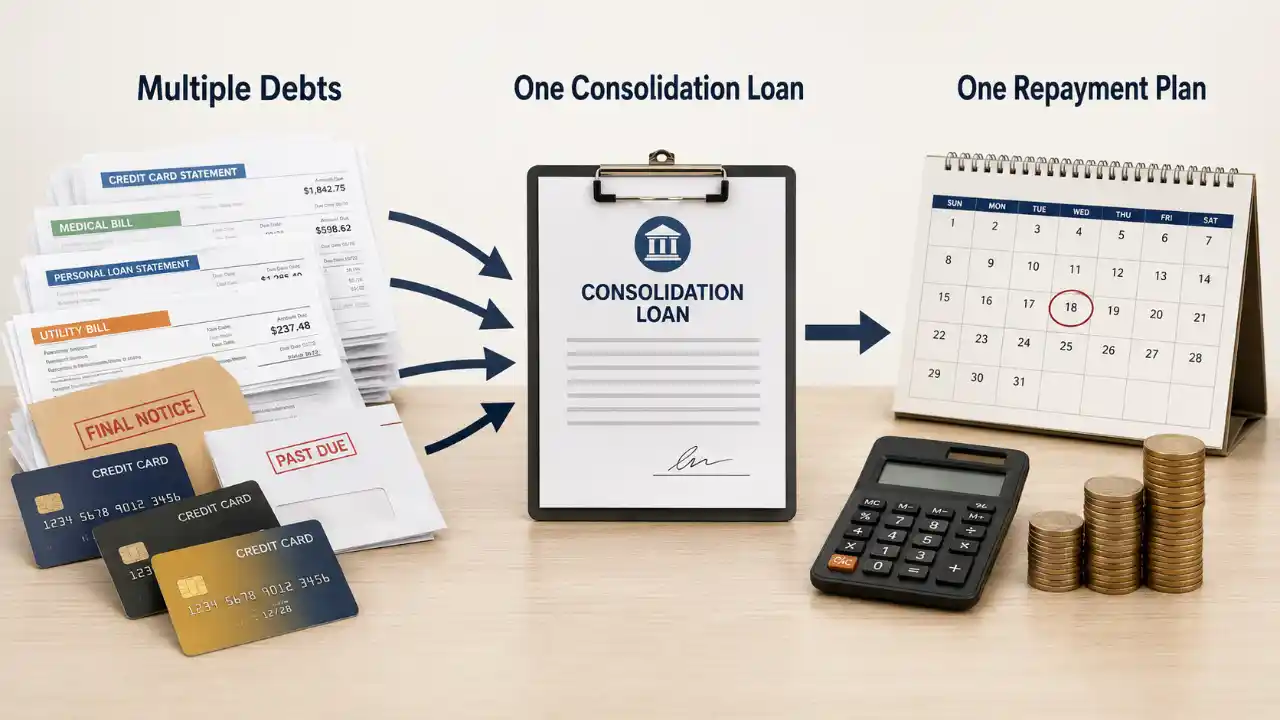
A debt consolidation loan combines multiple debts into one new loan and one scheduled payment. It may reduce borrowing costs when the new APR is meaningfully below the rates on existing debts, but a lower monthly payment does not automatically mean lower total cost. Fees, repayment term, credit qualification, and future borrowing behavior can all change the result.
Key Takeaways
- Compare APR, not just the advertised interest rate, because APR reflects the interest rate plus certain additional loan charges.
- A longer repayment term can lower the monthly payment while increasing total interest.
- Debt consolidation can affect credit through hard inquiries, credit utilization, new accounts, payment history, and the broader credit profile.
- Debt consolidation does not eliminate debt. It restructures existing obligations into a different repayment arrangement.
- Evaluate APR, fees, repayment term, monthly cash flow, and total repayment together rather than focusing only on monthly payment.This guide explains how debt consolidation loans work, how debt consolidation loan rates should be compared, which fees matter, how consolidation may affect credit, and how to evaluate repayment options without assuming that refinancing will automatically save money.
How Does a Debt Consolidation Loan Work?
A debt consolidation loan is money borrowed to repay multiple existing debts, generally leaving the borrower with one new loan to repay over time.Banks, credit unions, and other lenders may offer personal loans for debt consolidation. The Consumer Financial Protection Bureau explains that consolidation can convert multiple debts into a single loan payment.A typical structure looks like this:Credit Card A
- Credit Card B
- Existing Personal Loan→ Debt Consolidation Loan→ One Scheduled Monthly PaymentFor credit card debt consolidation, the new loan may simplify repayment by reducing the number of balances and due dates being managed.Debt consolidation does not eliminate debt.It restructures existing debt into a new obligation.Consolidation may be useful when it creates a clearer payoff schedule, lowers overall borrowing costs, or produces a payment structure that better fits the household budget. None of these outcomes is guaranteed.The CFPB also warns that a lower monthly payment may simply result from extending repayment over a longer period.
How Should Debt Consolidation Loan Rates Be Compared?
Debt consolidation loan rates should be evaluated using APR, applicable fees, repayment term, and total repayment.An interest rate is the basic rate charged for borrowing money. APR, or annual percentage rate, incorporates the interest rate plus certain additional charges used in the APR calculation, including origination fees.
Interest Rate vs. APR
| Measure | What It Shows | Why It Matters |
|---|---|---|
| Interest rate | Basic borrowing rate | Affects interest charges |
| APR | Interest rate plus certain additional charges | Provides a broader comparison of loan pricing |
| Monthly payment | Scheduled periodic payment | Shows immediate cash-flow impact |
| Repayment term | Length of the loan | Influences payment size and lifetime interest |
| Total repayment | Total scheduled amount paid | Helps measure overall borrowing cost |
Two loans can advertise similar interest rates but carry different fees. The loan with the lowest advertised rate is not automatically the least expensive.Comparing APR to APR generally provides a more consistent starting point.Lower monthly payment ≠ lower borrowing cost.
What Do Current Personal Loan and Credit Card Rates Show?
Federal Reserve data provide useful market context, but national averages should not be treated as personal loan offers.The Board of Governors of the Federal Reserve System reported in its Consumer Credit G.19 release dated August 7, 2026 that the average rate for 24-month personal loans at commercial banks was 11.86% during the second quarter of 2026.The same release reported an average rate of 22.15% for credit card accounts assessed interest.These figures help explain why debt consolidation refinancing can sometimes reduce borrowing costs when high-rate revolving debt is replaced by a lower-rate installment loan.However, the figures do not mean that an individual applicant will qualify for an 11.86% personal loan.Actual debt consolidation loan rates may vary based on lender underwriting, credit history, income, existing debt obligations, loan amount, repayment term, and product structure.These Federal Reserve figures are market benchmarks, not guaranteed personal borrowing rates.
Which Fees Can Change the Cost of Debt Consolidation?
Fees can materially change whether a consolidation loan reduces borrowing costs.Origination fees are particularly important because they may increase the effective cost of the transaction or reduce the proceeds available to repay existing balances.Before accepting a loan, review:
- Origination fees
- Application or processing charges, if applicable
- Late-payment fees
- Returned-payment fees
- Optional products or services
- Any applicable prepayment charge
- Whether fees are deducted from loan proceedsSuppose $20,000 is needed to repay existing debts. If a fee is deducted before funds are delivered, a nominal $20,000 loan may provide less than $20,000 for creditor payoff.Three figures should therefore be distinguished:Loan amount→ Net proceeds available→ Total scheduled repaymentAPR helps compare broader pricing, but borrowers should still review the actual fee structure and loan agreement.
Can a Lower Monthly Payment Still Cost More?
Yes.A longer repayment term can reduce the monthly payment while increasing lifetime interest.Consider an illustrative $18,000 fixed-rate loan at 12% with no additional fees:
| Repayment Term | Approx. Monthly Payment | Approx. Total Repaid | Approx. Interest |
|---|---|---|---|
| 36 months | $598 | $21,523 | $3,523 |
| 48 months | $474 | $22,752 | $4,752 |
| 60 months | $400 | $24,024 | $6,024 |
These figures are mathematical illustrations, not lender quotes.The 60-month structure requires a substantially smaller payment than the 36-month structure, but it also produces more interest over the full repayment period.Shorter term→ Higher monthly payment→ Potentially lower lifetime interestLonger term→ Lower monthly payment→ Potentially higher lifetime interestA longer term may still be appropriate when monthly cash flow is the primary constraint. It should be evaluated as a tradeoff rather than assumed to be a cost reduction.
When May Debt Consolidation Reduce Borrowing Costs?
Debt consolidation may reduce borrowing costs when the new repayment structure is economically better than the debts it replaces.A practical four-part test is:
- The new APR is meaningfully lower than the borrowing costs being replaced.
- Loan fees do not consume most of the expected interest savings.
- The repayment term is not extended enough to offset the lower rate.
- Paid-off credit card balances are not rebuilt after consolidation.The fourth factor is easy to overlook.When credit cards are paid down, available revolving credit may increase. If substantial new balances are accumulated, the borrower could end up with both a consolidation loan and renewed credit card debt.A better comparison is:Existing Debt Costvs.New Loan Principal + Interest + Feesrather than:Old Monthly Paymentsvs.New Monthly Payment
An $18,000 Debt Consolidation Example
Assume $18,000 of debt is modeled over 36 months at an annual rate of 22%.Under a simplified fixed-payment amortization assumption:Approximate monthly payment: $687Approximate total repayment: $24,747Approximate interest: $6,747Now assume the same $18,000 is refinanced into a 36-month loan at 12%, with no additional fees:Approximate monthly payment: $598Approximate total repayment: $21,523Approximate interest: $3,523Under those assumptions, the modeled interest difference is approximately $3,224.This example does not predict actual savings.Credit card accounts do not necessarily behave like fixed installment loans. Cardholders can make different payment amounts, continue using the accounts, and change their outstanding balances.An individual applicant is also not guaranteed a 12% consolidation loan.The example demonstrates a narrower principle: when principal and repayment duration remain similar, a substantially lower borrowing rate can reduce modeled interest expense.Fees or a significantly longer repayment term could change the outcome.
How Can Debt Consolidation Affect a Credit Score?
Debt consolidation can affect a credit profile in several directions.There is no guaranteed credit-score outcome.FICO explains that using a personal loan for credit card debt consolidation may affect FICO Scores positively or negatively depending on the existing credit profile and the scoring factors affected.
1. A Loan Application May Create a Hard Inquiry
Applying for a new consolidation loan may generate a hard inquiry.Hard inquiries can be considered in credit scoring. FICO also explains that personal-loan inquiries do not receive the same rate-shopping treatment commonly applied to qualifying mortgage, auto, and student-loan inquiries.Some lenders may offer prequalification or preapproval using a soft inquiry. FICO states that soft inquiries do not affect FICO Scores, although applicants should confirm a lender's process before submitting an application.
2. Paying Down Credit Cards May Reduce Credit Utilization
Credit utilization compares revolving balances with available revolving credit limits.Using an installment loan to pay down credit cards can reduce revolving utilization. FICO identifies utilization as an important factor within the amounts-owed category.However:Lower utilization ≠ guaranteed score increase.The outcome depends on the broader credit profile and the scoring model being used.
3. Opening the Loan Adds New Credit
A consolidation loan creates a new credit account.New accounts can affect factors such as average account age and recent credit activity. A consolidation transaction can therefore improve one part of a credit profile while affecting another negatively.
4. Payment History Continues to Matter
The consolidation loan still needs to be paid according to its terms.Payment history is an important credit-scoring factor, so future late or missed payments may affect the credit profile.Debt consolidation does not guarantee a higher credit score.
Should Paid-Off Credit Cards Be Closed?
Not automatically.Keeping a paid-off credit card open can preserve available revolving credit and may help maintain lower credit utilization.Keeping an account open may make sense when:
- It has no meaningful ongoing cost.
- Available credit supports lower utilization.
- New spending can be controlled.Closing it may make sense when:
- It carries an unwanted annual fee.
- Continued access contributes to repeated overspending.
- The account no longer provides practical value.The decision should consider both credit structure and spending behavior.
Which Debt Consolidation Repayment Option Is Better?
There is no universally superior debt consolidation option.Different strategies involve different combinations of borrowing cost, qualification requirements, repayment timelines, and risk.
| Option | Potential Advantage | Important Limitation |
|---|---|---|
| Fixed-rate personal loan | Predictable installment payment | Rate and fees depend on qualification |
| Balance-transfer credit card | Promotional rate may reduce short-term interest | Transfer fees and promotional expiration |
| Existing-creditor arrangement | May avoid opening a new loan | Terms depend on the creditor |
| Debt management plan | Structured repayment assistance | Different from refinancing |
| Home-equity borrowing | May offer different borrowing costs | Home serves as collateral |
Personal Loans for Debt Consolidation
A fixed-rate personal loan can provide a predictable monthly payment and defined payoff schedule.It may be useful when its APR and fees compare favorably with existing debts and the repayment term does not substantially increase lifetime borrowing costs.
Balance-Transfer Credit Cards
A balance transfer can function as short-term credit card refinancing.Promotional rates may lower short-term interest, but transfer fees may apply and the rate can change when the promotional period ends.This option may be more suitable when the borrower can repay a substantial portion of the transferred balance during the promotional period.
Working With Existing Creditors
Taking out a new loan is not the only possible response to repayment difficulty.Consumers may contact existing creditors to ask whether alternative payment arrangements are available. Available options vary by creditor and account.
Credit Counseling and Debt Management Plans
Credit counseling is different from debt consolidation refinancing.The Federal Trade Commission explains that a credit counselor may help create a budget and, when appropriate, develop a debt management plan.Under a debt management plan, the consumer generally makes payments through the counseling organization, which then pays participating creditors according to the arrangement.Consumers should review fees, services, creditor participation, and the organization itself before enrolling.
Home-Equity Consolidation
Home-equity borrowing changes the risk profile because the debt is secured by the home.CFPB and FTC consumer guidance warn that failure to repay home-secured debt can put the home at risk.A potentially lower rate should therefore be considered together with the increased collateral risk.
Debt Consolidation vs. Debt Settlement
Debt consolidation and debt settlement are not the same strategy.Debt consolidation generally restructures or refinances existing obligations into a different repayment arrangement.Debt settlement generally involves attempting to reach agreements in which creditors accept less than the full amount owed.Debt settlement can involve missed payments, additional interest or fees, collection activity, and uncertainty about whether creditors will agree to proposed settlements.FTC consumer guidance also identifies warning signs associated with problematic debt-relief services, including guaranteed debt forgiveness, prohibited advance fees, and unexplained instructions to stop communicating with creditors.A service marketed using the language of “debt consolidation” should therefore be reviewed carefully to determine whether it actually provides:
- A consolidation loan
- Credit counseling
- A debt management plan
- Debt settlementThese differences can materially change both cost and risk.
A Six-Factor Debt Consolidation Decision Framework
A consolidation offer can be evaluated across six factors.
1. APR
Is the new APR meaningfully below the borrowing costs being replaced?
2. Fees
How much will applicable charges add to the transaction?
3. Repayment Term
Will the new loan shorten, preserve, or substantially extend the expected payoff timeline?
4. Monthly Cash Flow
Can the scheduled payment be made consistently without relying on additional borrowing for ordinary expenses?
5. Total Repayment
How much is scheduled to be paid over the full term?
6. Post-Consolidation Debt Behavior
What will happen to the credit cards after their balances are paid?This framework distinguishes two different outcomes:Cost reduction→ Lower APR + controlled fees + reasonable repayment termPayment restructuring→ Lower monthly payment + longer repayment periodBoth may have practical value, but they solve different financial problems.
Debt Consolidation Loan Checklist
Before accepting a debt consolidation loan:
- Verify the APR and compare it with the debts being refinanced.
- Confirm whether the rate is fixed or variable.
- Identify all applicable fees and how they affect net proceeds.
- Confirm which debts can be repaid with the loan.
- Compare the new payoff date with the existing repayment timeline.
- Review total scheduled repayment.
- Determine whether the application requires a hard inquiry.
- Review applicable prepayment terms.
- Confirm that the monthly payment fits the budget.
- Decide how paid-off credit cards will be managed.
- Avoid assuming approval, savings, or a credit-score increase is guaranteed.
Common Debt Consolidation Mistakes
Focusing Only on the Monthly Payment
A lower payment may improve cash flow without reducing total borrowing costs.
Comparing Interest Rates Without APR
Interest rate and APR measure different aspects of loan pricing. APR provides a broader comparison because it incorporates certain additional charges.
Overlooking Net Loan Proceeds
If fees are deducted before funds are distributed, the amount available to repay creditors may be lower than the stated loan amount.
Rebuilding Credit Card Balances
Accumulating new revolving debt after consolidation can leave a borrower managing both the new loan and renewed credit card balances.
Assuming Credit Will Automatically Improve
Hard inquiries, new accounts, credit utilization, account age, and payment history can affect credit differently.A higher score is not guaranteed.
Confusing Consolidation With Debt Forgiveness
Debt consolidation changes how debt is repaid. It does not automatically reduce the principal owed.
Troubleshooting: What If a Consolidation Offer Does Not Work?
The APR Is Too High
Compare the offer with the actual debts being replaced.If the consolidation APR is similar to or higher than existing borrowing costs, the main benefit may be payment simplification rather than interest savings.
The Payment Is Still Unaffordable
Extending the term may reduce the monthly payment but can increase total interest.Consumers having difficulty making required payments may also consider contacting creditors or reviewing reputable credit-counseling options.
The Loan Does Not Provide Enough Net Proceeds
Check whether origination or other charges are deducted before proceeds are distributed.The stated principal should not automatically be treated as the amount available to repay creditors.
The Offer Promises Guaranteed Debt Relief
Use caution.The FTC warns consumers about debt-relief operations that promise guaranteed or unusually fast forgiveness, demand prohibited upfront fees, or encourage consumers to stop communicating with creditors without clearly explaining the consequences.
Final Takeaway
Debt consolidation loans can simplify repayment and may reduce borrowing costs, but the decision should be based on the complete repayment structure rather than on a lower monthly payment alone.For borrowers with high-rate revolving balances who qualify for a meaningfully lower APR, reasonable fees, and a manageable repayment term, consolidation may reduce modeled interest expense and provide a clearer payoff schedule.For borrowers offered high debt consolidation loan rates or substantial fees, the financial benefit may be limited.For borrowers primarily seeking lower monthly payments, a longer term may improve cash flow while increasing lifetime interest.For borrowers already struggling to meet required payments, communication with creditors or reputable credit counseling may deserve consideration before adding another loan.A practical comparison is:APR→ Fees→ Repayment Term→ Monthly Payment→ Total Repayment→ Credit Impact→ Post-Consolidation Debt PlanDebt consolidation may reduce borrowing costs when the new APR, fees, and repayment term produce a lower overall repayment cost.It does not guarantee savings, loan approval, or a higher credit score.
Frequently Asked Questions
Does a debt consolidation loan automatically lower interest costs?
No.Debt consolidation may reduce interest costs when the new APR is sufficiently lower and fees or a longer repayment term do not offset the savings.A lower monthly payment alone does not establish a lower overall cost.
Does debt consolidation hurt a credit score?
It can affect a credit score, but the result is not predetermined.A new personal loan may involve a hard inquiry and new account, while paying down revolving card balances may reduce utilization. Payment history and the broader credit profile also matter.
Is it better to pay off credit cards or get a consolidation loan?
It depends on the economics of the available options.If existing balances can be repaid efficiently without refinancing, another loan may provide limited financial benefit. If consolidation materially reduces APR while keeping fees and repayment duration under control, refinancing may provide a stronger cost advantage.
What is a good debt consolidation loan rate?
There is no single rate that is good for every borrower.The more useful comparison is between the new loan's APR and the borrowing costs being replaced. Federal Reserve averages provide market context, but they do not determine the rate available to a specific applicant.
Is a balance transfer better than a personal loan?
Neither is automatically better.A balance transfer may be useful when promotional pricing is favorable and the transferred balance can be reduced substantially during the promotional period. A personal loan may provide a more predictable repayment schedule.Fees, APRs, promotional terms, and expected payoff time should all be compared.
Should credit cards be closed after debt consolidation?
Not automatically.Keeping a paid-off card open may preserve available revolving credit, while closing it may make sense when annual fees or overspending risk are significant.The appropriate decision depends on both the credit profile and spending behavior.
Financial Information Notice
This article provides general educational information and is not individualized financial, credit, tax, or legal advice. Loan approval, interest rates, fees, credit-score effects, and repayment outcomes can vary by lender, product terms, credit profile, income, existing debt obligations, scoring model, and individual financial circumstances.
Sources
Consumer Financial Protection Bureau — “What do I need to know if I'm thinking about consolidating my credit card debt?”https://www.consumerfinance.gov/ask-cfpb/what-do-i-need-to-know-if-im-thinking-about-consolidating-my-credit-card-debt-en-1861/Consumer Financial Protection Bureau — “What is the difference between a loan interest rate and the APR?”https://www.consumerfinance.gov/ask-cfpb/what-is-the-difference-between-a-loan-interest-rate-and-the-apr-en-733/Consumer Financial Protection Bureau — “What is the difference between credit counseling and debt settlement, debt consolidation, or credit repair?”https://www.consumerfinance.gov/ask-cfpb/what-is-the-difference-between-credit-counseling-and-debt-settlement-debt-consolidation-or-credit-repair-en-1449/Board of Governors of the Federal Reserve System — Consumer Credit G.19 — August 7, 2026https://www.federalreserve.gov/releases/g19/current/FICO — “How a Debt Consolidation Loan Impacts Your FICO® Scores”https://www.myfico.com/credit-education/blog/debt-consolidation-fico-scoreFederal Trade Commission — “How To Get Out of Debt”https://consumer.ftc.gov/articles/how-get-out-debtFederal Trade Commission — “Looking for debt relief? Here's how to avoid a scam.” — March 26, 2026https://consumer.ftc.gov/consumer-alerts/2026/03/looking-debt-relief-heres-how-avoid-scamSource information checked August 17, 2026.