Mortgage Rates Explained: What Affects Home Loan Rates, Monthly Payments, and Total Interest
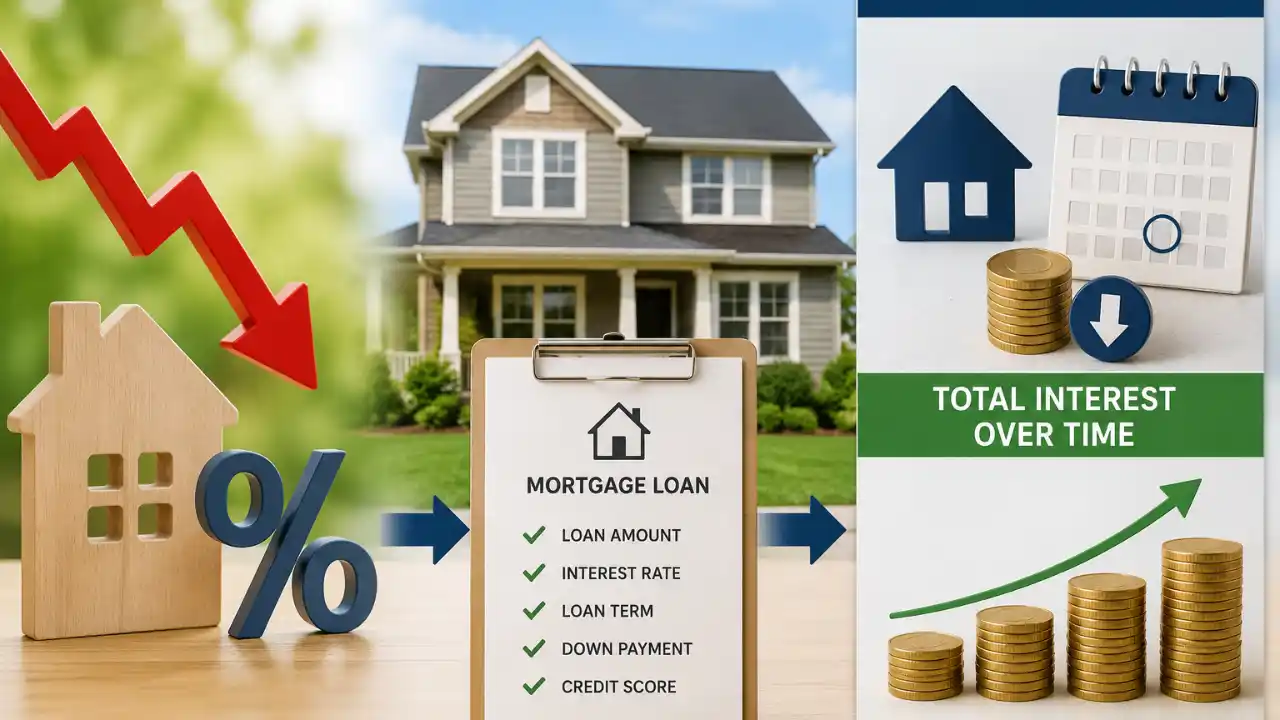
Mortgage rates affect both the monthly principal-and-interest payment on a home loan and the amount of interest that may be paid over time. A borrower’s actual rate can depend on market conditions, credit profile, down payment, loan type, term, points, property characteristics, and lender pricing. A national average does not guarantee the rate an individual borrower will receive.
Key Takeaways
- Mortgage rates are influenced by broad financial-market conditions as well as borrower-specific and loan-specific factors.
- A lower mortgage interest rate generally reduces principal-and-interest payments when the loan amount and term remain the same.
- 30-year mortgage rates may produce lower monthly payments than shorter-term financing, but a longer repayment period can substantially increase total interest.
- Interest rate and APR are different. APR generally includes the mortgage rate plus certain additional loan charges, including points and some fees.
- Mortgage refinance rates should be evaluated together with closing costs, the new repayment term, and how long the new loan is expected to remain outstanding.This guide explains what affects home loan rates, how rate differences change monthly payments and total interest, how discount points and lender credits work, and how to compare purchase and refinance mortgages without assuming that an advertised rate applies to every borrower.
What Are Current Mortgage Rates?
Mortgage rates change frequently, so any current-rate figure should be tied to a specific date and treated as a market benchmark rather than a personal loan offer.As of August 13, 2026, Freddie Mac’s Primary Mortgage Market Survey reported an average 6.67% rate for 30-year fixed-rate mortgages and 5.96% for 15-year fixed-rate mortgages. Freddie Mac releases PMMS results weekly and reports averages based on qualifying mortgage applications submitted through participating lenders.These figures are market benchmarks, not guaranteed home loan rates for an individual applicant.A borrower may receive a rate above or below a national average because of differences in:
- credit profile
- down payment
- loan-to-value ratio
- loan amount
- repayment term
- property type
- occupancy
- loan program
- discount points
- lender pricing
- rate-lock timingCurrent mortgage rates can also change between the day a borrower begins shopping and the day a mortgage closes.This makes the date attached to any “current mortgage rate” important. A rate published several weeks or months earlier may no longer describe prevailing market conditions.
What Actually Determines Mortgage Rates?
Mortgage pricing can be understood through three broad layers:Market Conditions → Borrower and Property Risk → Loan Structure and Lender PricingEach layer can affect the final rate or the cost associated with obtaining that rate.
| Pricing Layer | Examples | Possible Effect |
|---|---|---|
| Financial markets | Treasury yields, mortgage-backed securities, inflation expectations | Changes the general rate environment |
| Borrower and property | Credit profile, down payment, LTV, occupancy | May affect risk-based pricing |
| Loan structure | Term, fixed vs. adjustable, purchase vs. refinance | May change rate and fees |
| Pricing choices | Discount points, lender credits, rate lock | Changes upfront cost versus ongoing interest |
| Lender factors | Funding costs, competition, internal pricing | Can create differences between lenders |
The CFPB identifies credit score, home location, home price and loan amount, down payment, loan term, interest-rate type, and loan type as factors that can affect mortgage pricing.Mortgage interest rates therefore do not move because of only one factor.Two borrowers applying on the same day may receive different rates. The same borrower may also receive different quotes from multiple lenders because lender pricing and loan structures can differ.
Does the Federal Reserve Directly Set Mortgage Rates?
No. The Federal Reserve does not directly set 30-year mortgage rates.Long-term mortgage rates are influenced by conditions in longer-term bond and mortgage-backed securities markets. Research from the Federal Reserve discusses the relationship among Treasury yields, agency mortgage-backed securities, mortgage spreads, and primary mortgage rates.Federal Reserve monetary policy can influence financial conditions, inflation expectations, bond yields, and other market variables that may affect mortgage rates indirectly.However:Federal Reserve policy rate ≠ 30-year mortgage rate.A Federal Reserve rate cut does not guarantee that mortgage rates will fall by the same amount. Mortgage markets may already have incorporated expected policy changes, and longer-term bond yields can move differently from short-term policy rates.
How Does a Credit Score Affect Mortgage Interest Rates?
A credit score can affect mortgage pricing because lenders and underwriting systems may use credit information when evaluating credit risk.The Consumer Financial Protection Bureau explains that credit scores and credit-report information can affect mortgage eligibility and the interest rate available to a borrower. Higher scores generally may be associated with access to lower rates, but no particular credit score guarantees approval or guarantees the lowest mortgage rate.The relationship is better understood as:Credit Profile → Risk Assessment → Potential Pricing EffectIt should not be interpreted as:Specific Credit Score → Guaranteed Mortgage RateSomeone with a strong score may still receive different offers from two lenders because their fees, loan structures, pricing methods, points, and rate-lock terms can differ.A lower score also does not automatically mean every mortgage application will be denied. Loan eligibility can depend on the mortgage program, underwriting method, income, existing debt, property, and other factors.
How Does the Down Payment Affect Home Loan Rates?
A down payment changes how much of the home’s value must be financed.Loan-to-value ratio, or LTV, compares the mortgage balance with the value used for the applicable loan calculation. A larger down payment generally results in a lower LTV.The CFPB identifies down payment as one of several factors that can affect mortgage interest rates.However:Larger down payment ≠ guaranteed lower mortgage rate.A larger down payment may still reduce borrowing costs even if the rate remains unchanged because the borrower is financing a smaller principal balance.Down payment size can also affect mortgage insurance, cash reserves, and the amount of liquid savings remaining after closing. These considerations make down-payment decisions broader than rate shopping alone.
Does Loan Type Affect Mortgage Interest Rates?
Yes. Different mortgage products can have different eligibility requirements, pricing structures, insurance requirements, and upfront costs.Common categories include:
- conventional mortgages
- FHA loans
- VA loans
- USDA loans
- fixed-rate mortgages
- adjustable-rate mortgages
- purchase mortgages
- rate-and-term refinances
- cash-out refinancesThe CFPB notes that different loan types have different features, eligibility requirements, and cost structures.A lower quoted rate does not automatically mean one loan type is cheaper overall.One mortgage may have a lower rate but higher mortgage insurance or upfront charges. Another may have a higher rate but lower cash-to-close requirements.That leads to an important distinction:Mortgage rate ≠ total mortgage cost.
30-Year vs. 15-Year Mortgage: Which Costs Less?
A shorter mortgage term generally requires a higher monthly payment but can substantially reduce total interest because the principal is repaid faster.A 30-year mortgage spreads repayment over more months. This generally reduces the required monthly principal-and-interest payment compared with a shorter mortgage of the same balance, but it can increase cumulative interest.The CFPB explains that shorter-term loans generally cost less overall because interest is paid for fewer years and shorter terms commonly carry lower rates, although their monthly payments are higher.When comparing a 15-year mortgage with a 30-year mortgage, consider:
- mortgage interest rate
- monthly principal and interest
- total scheduled interest
- cash-flow flexibility
- expected time in the home
- ability to handle the higher required paymentA shorter mortgage may cost less if kept for the full term, but that does not automatically make it the better fit for every household.
Fixed-Rate vs. Adjustable-Rate Mortgage: What Changes?
A fixed-rate mortgage maintains the same interest rate for the life of the loan.An adjustable-rate mortgage, or ARM, can change after its initial fixed-rate period according to the loan terms.An ARM may sometimes begin with a lower interest rate than a comparable fixed-rate mortgage. However, the introductory rate does not establish what the rate or payment will be after future adjustments.The principal tradeoff is:Fixed Rate → Greater payment predictabilityAdjustable Rate → Potentially lower initial pricing + future rate uncertaintySomeone comparing an ARM with a fixed-rate mortgage should therefore consider the adjustment schedule, underlying index, margin, rate caps, and potential future payments rather than examining only the introductory rate.An ARM should not automatically be considered cheaper simply because its starting rate is lower.
Mortgage Interest Rate vs. APR: What Is the Difference?
The mortgage interest rate measures the percentage charged for borrowing the principal.APR, or annual percentage rate, is a broader measure of borrowing cost.The CFPB explains that mortgage APR reflects the interest rate plus certain other charges, including applicable points, mortgage broker fees, and other costs used in the APR calculation.Consider two hypothetical mortgage offers:
| Offer | Interest Rate | APR |
|---|---|---|
| Mortgage A | 6.50% | 6.72% |
| Mortgage B | 6.375% | 6.81% |
Mortgage B has the lower stated interest rate, but its higher APR suggests that it includes greater applicable finance charges under the APR calculation.This does not automatically make Mortgage A the better mortgage.How long the loan remains outstanding and which costs are paid upfront can affect which pricing structure is more favorable for a particular borrowing situation.A complete comparison should consider:
- interest rate
- APR
- discount points
- origination charges
- lender credits
- monthly payment
- cash to close
- expected holding period
How Do Discount Points and Lender Credits Affect Mortgage Rates?
Discount points generally allow a borrower to pay more upfront in exchange for a lower mortgage rate.The CFPB states that one point equals 1% of the loan amount.For a $400,000 mortgage:1 point = $4,000Paying points increases cash required at closing but can reduce the mortgage interest rate.Lender credits generally work in the opposite direction. The lender provides money toward closing costs in exchange for a higher interest rate.The tradeoff can be summarized as:
| Pricing Choice | Upfront Cost | Mortgage Rate | Main Tradeoff |
|---|---|---|---|
| Discount points | Higher | Lower | More cash upfront, potentially less interest |
| No points | Moderate | Moderate | Middle-ground pricing |
| Lender credits | Lower | Higher | Less cash upfront, potentially more interest |
No option is universally superior.A useful question is whether the monthly savings associated with paying points are likely to exceed the upfront cost during the period the mortgage is expected to remain outstanding.
How Much Can a Mortgage Rate Change the Monthly Payment?
A mortgage rate can materially change the principal-and-interest payment even when the loan amount and repayment term remain exactly the same.Consider a hypothetical $400,000, 30-year fixed-rate mortgage.The 6.25% and 7.25% rates below are illustrative assumptions only. They are not current mortgage quotes, do not represent current 30-year mortgage rates, and are not guaranteed rates for any credit profile.
| Example | Hypothetical Rate | Approx. Monthly Principal & Interest | Approx. Total Interest |
|---|---|---|---|
| Mortgage A | 6.25% | $2,463 | $486,633 |
| Mortgage B | 7.25% | $2,729 | $582,334 |
Under these assumptions, the one-percentage-point difference changes principal and interest by approximately $266 per month.If both mortgages remain outstanding for all 360 scheduled payments, Mortgage B would generate approximately $95,701 more in total interest.These are mathematical illustrations rather than predictions.The calculations exclude:
- property taxes
- homeowners insurance
- mortgage insurance
- HOA dues
- closing costs
- points
- lender credits
- refinancing
- additional principal payments
- early payoffThe example illustrates why even a relatively small mortgage-rate difference can become financially significant when applied to a large balance for many years.
What Is Included in a Monthly Mortgage Payment?
The principal-and-interest payment is only part of the total monthly housing cost for many homeowners.A common framework is:Principal + Interest + Property Taxes + Homeowners Insurance + Mortgage Insurance, when applicablePrincipal reduces the outstanding mortgage balance.Interest is the borrowing charge determined by the loan balance and applicable interest rate.Property taxes and homeowners insurance may be collected through an escrow account depending on the loan and servicing arrangement.Mortgage insurance may also apply to some transactions.HOA dues can represent an additional recurring housing expense but may be paid separately.Therefore:Principal and interest ≠ total monthly housing cost.A mortgage calculator that displays only principal and interest may show a figure below the household’s actual recurring housing expense.
Can a Lower Monthly Mortgage Payment Still Cost More?
Yes.A lower monthly payment can result from a lower interest rate, but it can also result from stretching repayment over more years.This issue becomes particularly important when comparing mortgage refinance rates.Suppose a homeowner has already made payments on a 30-year mortgage for several years and refinances the remaining balance into a new 30-year loan.The new monthly payment could decrease because:
- the mortgage interest rate is lower,
- the remaining principal is smaller,
- repayment has been extended over a new term,
- or a combination of these factors.Only comparing the old payment with the new payment does not reveal why the payment declined.Therefore:Lower monthly payment ≠ lower total interest.A refinance comparison should evaluate future borrowing costs as well as monthly cash flow.
How Should Mortgage Refinance Rates Be Evaluated?
Mortgage refinance rates should be evaluated together with the complete cost of replacing the existing mortgage.A refinance creates a new mortgage and commonly involves closing costs.A useful four-question framework is:
1. How Much Lower Is the New Rate?
Compare the proposed mortgage refinance rate with the rate on the existing mortgage.A lower rate may reduce borrowing costs, but the size of the difference matters.There is no universal rule stating that a particular rate reduction automatically makes refinancing worthwhile.
2. What Are the Closing Costs?
Refinancing is not cost-free simply because a new monthly payment is smaller.Possible expenses can include lender charges, appraisal costs, title-related costs, points, and other transaction expenses.
3. What Is the Break-Even Period?
A basic screening calculation is:Eligible upfront refinance costs ÷ estimated monthly savingsFor example, suppose eligible refinancing costs are $6,000 and estimated monthly savings are $200.$6,000 ÷ $200 = 30 monthsUnder this simplified calculation, it would take approximately 30 months of monthly savings to recover the specified upfront costs.This is only a basic screening calculation, not a complete financial return model.It does not automatically account for changes in amortization, tax considerations, opportunity cost, differences in loan balances, or future changes to the mortgage.
4. Is the Loan Term Being Reset?
A new 30-year refinance after several years of repayment may reduce the payment while extending the remaining repayment schedule.Compare future costs under the existing mortgage with the proposed refinance rather than assuming that a lower mortgage refinance rate automatically creates savings.Lower refinance rate ≠ guaranteed lower total cost.
How Should Two Mortgage Offers Be Compared?
Mortgage offers are easiest to compare when their main assumptions are similar.A useful Five-Factor Mortgage Comparison Framework is:
1. Rate
What is the mortgage interest rate?Is it fixed or adjustable?
2. APR
What additional finance charges are reflected in the APR?
3. Cash to Close
How much money is required at closing?Are discount points or lender credits included?
4. Monthly Cost
What is the required principal-and-interest payment?What estimated taxes, insurance, and mortgage insurance may apply?
5. Holding-Period Cost
How much is the mortgage expected to cost during the period it is likely to remain outstanding?The CFPB recommends comparing Loan Estimates when evaluating lenders and mortgage offers.This framework helps separate the smallest advertised rate from the mortgage that may have the most suitable overall cost structure.
What Should Be Checked on a Loan Estimate?
A Loan Estimate is one of the most useful documents for comparing mortgage offers.Review:
- loan amount
- interest rate
- whether the rate is fixed or adjustable
- monthly principal and interest
- estimated total payment
- mortgage insurance
- estimated taxes and insurance
- origination charges
- discount points
- lender credits
- other closing costs
- cash to close
- APR
- rate-lock status
- rate-lock expiration dateWhen possible, compare offers based on approximately the same loan amount, repayment term, rate structure, point structure, and lock period.Otherwise, two quoted mortgage rates may represent fundamentally different transactions.
How Does a Mortgage Rate Lock Work?
A mortgage rate lock generally protects a specified rate for a defined period, assuming the transaction meets the lender’s applicable conditions and closes before the lock expires.CFPB mortgage guidance notes that rate locks are commonly available for periods such as 30, 45, or 60 days, although lender policies and available lock periods vary.Changes in important loan information may affect the transaction, potentially including changes involving:
- loan amount
- down payment
- credit profile
- verified income
- property appraisal
- mortgage typeClosing delays can also create problems if the lock expires.Therefore:Quoted rate ≠ necessarily locked rate.When comparing lenders, determine whether each quote is locked and whether the quoted lock periods are comparable.
Common Mortgage Rate Comparison Mistakes
Mistake 1: Treating a National Average as a Personal Offer
Freddie Mac’s PMMS describes market averages.It does not establish the exact rate a particular borrower will receive.
Mistake 2: Comparing Rates With Different Point Structures
A 6.25% mortgage purchased with significant discount points is not directly comparable with a 6.50% mortgage carrying no points.Upfront cost matters.
Mistake 3: Ignoring APR
APR can show certain finance charges that are not apparent from the mortgage interest rate alone.
Mistake 4: Looking Only at Monthly Payment
A smaller payment can result from a longer repayment term rather than lower borrowing costs.
Mistake 5: Assuming Refinancing Is Worthwhile Because the Rate Is Lower
Closing costs, the remaining term on the existing mortgage, and the new repayment schedule can materially affect the result.Refinancing does not guarantee savings.
Mistake 6: Assuming the Federal Reserve Directly Sets Mortgage Rates
Federal Reserve policy can influence broader financial conditions, but it does not mechanically set the rate on a 30-year fixed mortgage.
Mistake 7: Comparing an ARM Introductory Rate With a Fixed Rate Without Considering Adjustments
An ARM’s initial interest rate is only part of the loan structure.Future rates and payments may change.
What If the Mortgage Rate Changes Before Closing?
First determine whether the quoted rate was locked.If the rate was not locked, changing market conditions may affect mortgage pricing before closing.If the rate was locked but the rate or costs changed, review whether important information about the transaction also changed.A practical troubleshooting process is:
- Review the newest Loan Estimate.
- Confirm whether the rate was locked.
- Check the rate-lock expiration date.
- Compare the original and revised loan terms.
- Look for changes involving the loan amount, appraisal, credit profile, income, or down payment.
- Ask the lender to explain the specific reason for the change.
- Review the Closing Disclosure before closing.The goal is to identify what changed rather than assume every pricing change resulted from market rates.
Which Mortgage Rate Strategy Fits Different Situations?
There is no universally best mortgage-rate strategy.A homebuyer expecting to keep the same mortgage for many years may place greater weight on long-term interest expense and whether paying discount points is likely to break even.A buyer expecting to sell or refinance sooner may place more weight on upfront closing costs and may have less time to recover the cost of points.Someone prioritizing predictable payments may place greater value on a fixed-rate mortgage even when an ARM has a lower introductory rate.A homeowner considering refinancing can compare mortgage refinance rates together with closing costs, break-even time, remaining term, and expected future interest.Someone comparing lenders can make the comparison more useful by using equivalent loan amounts, repayment terms, point structures, and rate-lock periods.The goal is not simply to find the smallest percentage displayed in an advertisement.A more complete framework is:Rate → Payment → Upfront Cost → Holding-Period Cost → Total Financial Impact
Final Takeaway
Mortgage rates affect monthly payments and total interest, but the interest rate is only one part of the cost of a home loan.Credit profile, down payment, mortgage type, repayment term, APR, mortgage insurance, discount points, lender credits, closing costs, refinance purpose, and rate-lock timing can all change the financial outcome.For a homebuyer, comparing equivalent Loan Estimates generally provides more information than relying on advertised home loan rates.For someone choosing between a 15-year and 30-year mortgage, both monthly affordability and total scheduled interest matter.For a homeowner evaluating mortgage refinance rates, the comparison should include closing costs, break-even time, remaining loan term, and expected future interest—not the new rate alone.And when reviewing current 30-year mortgage rates, remember that national averages describe the market rather than guaranteeing a personal offer.
FAQ
Why do mortgage rates change so often?
Mortgage rates respond to changing conditions in financial markets, including Treasury yields, mortgage-backed securities, inflation expectations, and lender pricing. Federal Reserve policy can influence those conditions, but the Federal Reserve does not directly set the rate on a 30-year mortgage.
Does a higher credit score guarantee a lower mortgage rate?
No. A higher credit score may improve access to more favorable pricing, but it does not guarantee a particular mortgage rate. Down payment, loan structure, lender pricing, property characteristics, and market conditions can also affect the offer.
Are 30-year mortgage rates always higher than 15-year rates?
Not as an absolute rule, but shorter-term mortgages commonly carry lower rates. Their required monthly payments are generally higher because the principal must be repaid over fewer years.
Is a lower mortgage rate always the better deal?
No. A lower mortgage rate may require discount points or other higher upfront costs. APR, cash to close, monthly payment, repayment term, and expected holding period should also be considered.
When may refinancing reduce borrowing costs?
Refinancing may reduce borrowing costs when the financial benefits of the new mortgage outweigh the costs of replacing the existing loan. The outcome can depend on the rate difference, closing costs, new term, monthly savings, and how long the homeowner keeps the new mortgage. A lower refinance rate alone does not guarantee savings.
Can a mortgage rate change after it has been locked?
A rate lock generally protects the specified rate for the stated period if applicable conditions continue to be met. Lock periods and lender policies vary, and changes to important loan or borrower information may affect the transaction.
Sources
Consumer Financial Protection Bureau — Explore Interest Rateshttps://www.consumerfinance.gov/owning-a-home/explore-rates/Consumer Financial Protection Bureau — Seven Factors That Determine Your Mortgage Interest Ratehttps://www.consumerfinance.gov/archive/blog/7-factors-determine-your-mortgage-interest-rate/Consumer Financial Protection Bureau — Mortgage Interest Rate vs. APRhttps://www.consumerfinance.gov/ask-cfpb/what-is-the-difference-between-a-mortgage-interest-rate-and-an-apr-en-135/Consumer Financial Protection Bureau — Discount Points and Lender Creditshttps://www.consumerfinance.gov/ask-cfpb/how-should-i-use-lender-credits-and-points-also-called-discount-points-en-136/Consumer Financial Protection Bureau — Compare Loan Estimateshttps://www.consumerfinance.gov/owning-a-home/compare/compare-loan-estimates/Freddie Mac — Primary Mortgage Market Surveyhttps://www.freddiemac.com/pmmsFannie Mae — What Determines the Rate on a 30-Year Mortgage?https://www.fanniemae.com/research-and-insights/publications/housing-insights/rate-30-year-mortgageFederal Reserve — Agency Mortgage-Backed Securities Researchhttps://www.federalreserve.gov/econres/notes/feds-notes/the-evolution-of-the-federal-reserves-agency-mbs-holdings-20240920.htmlSource information checked August 17, 2026.Financial Information Notice: This article provides general educational information about mortgage rates, home loans, monthly payments, refinancing, and borrowing costs. It is not individualized financial, mortgage, tax, legal, or credit advice. Mortgage eligibility, interest rates, APRs, fees, loan terms, and underwriting requirements may vary by lender, loan program, borrower profile, property, and market conditions.